Everybody quotes the lumens. Almost nobody quotes where the light goes.
Customized Flashlights makes laser-engraved anodised aluminium torches, rechargeable USB-C builds, long-throw and high-CRI flood lights, pocket sizes and magnetic-base roadside lights — quoted by the beam, the driver and the cell.
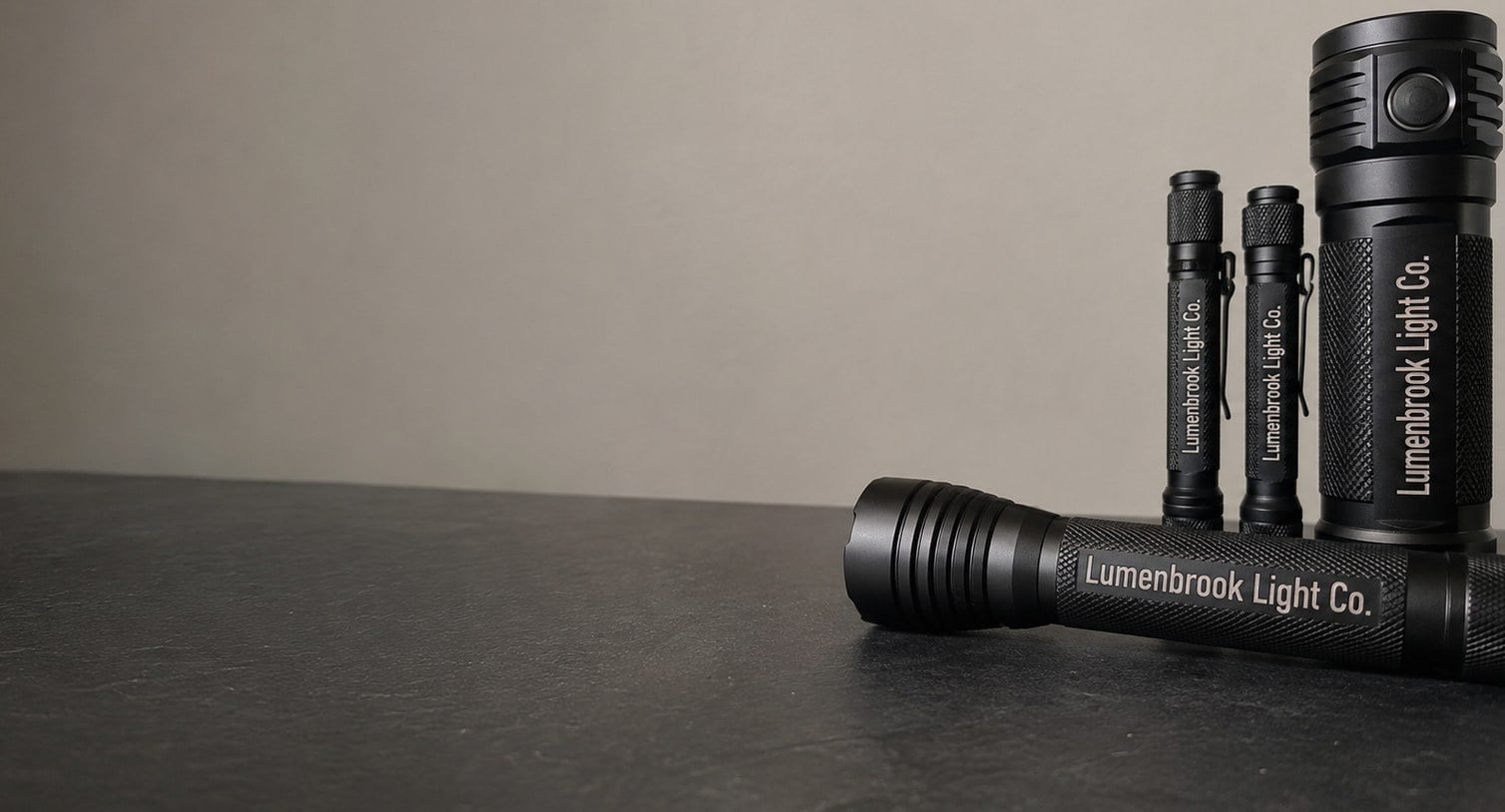
A torch is bought on one number. More lumens is assumed to be a better torch, and it is printed on the box in the largest type available.
Lumens measure the total light coming out in every direction. They say nothing at all about where any of it lands, which is the only thing the buyer actually cares about.
Two more numbers finish the job, and neither is usually offered: whether the output stays where it started, and whether the branding survives the first year.
Why we exist
Torches are compared on a lumen figure and a price, and the three things that decide whether one is any good — the beam, the runtime curve and the mark — are on nobody’s quote.
All three are settled before anything is made, and none of them is expensive.
Lumens versus candela
Lumens are total output. Candela is intensity in the direction you are pointing, and that is what reaches a fence line eighty metres away.
Two torches with identical lumens can differ fivefold in beam distance depending on the reflector and the emitter. So we quote candela and beam distance, and ask what you need to see before recommending anything.
Runtime is a curve
A regulated driver holds output roughly flat and then drops. A direct-drive circuit starts at the headline figure and is at a fraction of it within minutes.
The ANSI FL1 convention quotes runtime until output falls to a tenth of initial, which is how a torch honestly claims twelve hours and is useful for one. We state whether the driver is regulated and quote runtime at a stated output.
Throw and flood are opposite tools
A tight column identifies something at distance and is genuinely worse than a cheap flood for anything at arm’s length, because the hotspot creates hard shadows and glare.
Close work also wants high colour rendering — identifying a wire, judging a fluid, spotting corrosion. Cheap cool-white emitters wash all of that into grey-blue.
The mark has to outlive the barrel
A promotional torch lives in a toolbox, a glovebox or a pocket full of keys. A pad print on that barrel is a ghost within a year.
A laser engrave burns through the anodising and removes material, so the mark is part of the barrel. Hard-anodising resists abrasion far better than the decorative finish most promotional torches use, and takes a cleaner engrave.
The cell decides whether it gets used
A torch taking a battery nobody stocks is a torch in a drawer, whatever it does on paper.
Where a rechargeable suits better we specify a replaceable cell rather than a sealed one, so the torch outlives its battery — and we tell you about lithium freight restrictions before you order rather than when a date slips.
What we will talk you out of
The biggest lumen figure when the work is all at arm’s length. A thrower as somebody’s only torch. A sealed rechargeable. A proud tail switch on a keychain torch, which will arrive flat.
And anything certified — these are work and everyday torches, not intrinsically safe, not marine or aviation lamps, and the red mode is not a warning beacon. Where a certified device is required we will say so and point you elsewhere.
How we work
ASK
What you need to see, how far away it is, and where the torch lives.
SPEC
Beam type, candela, CRI, driver, cell, switch and anodising.
PROOF
Engrave proofed on the actual barrel finish.
MOCK
Free mockup within 24 hours.
SHIP
About 2 weeks, with lithium freight confirmed before you commit.
Who we serve
Get in touch
Text or call George at (929) 605-4397, or email info@customizedflashlights.com. Free mockups, low minimums, and a lowest-price guarantee.
Win Free Stuff
Enter below for a chance to win plus receive 10% off your first order.
🎉 You are in!
We will text you your 10% off code. Good luck!