Two flashlights can both print “1,000 lumens” on the package and perform nothing alike in the field. One might hold that output for three minutes and then sag; the other might throw its beam twice as far from the same lumen count. The numbers only mean something when they are measured the same way, which is exactly the problem a testing standard solves. If you are buying custom flashlights for a crew, a giveaway, or resale, learning to read the spec sheet the way the standard defines it keeps you from paying for a headline figure that does not survive contact with reality.
Why flashlight specs need a standard
The reference that brings order to the category is the ANSI/PLATO FL1 standard. It defines how each performance number is measured — the test conditions, the timing, the pass criteria — so that one brand’s lumens can be compared with another’s. A spec sheet that cites FL1 is telling you the figures were gathered under a common protocol rather than a marketing department’s best-case guess. The 2025 revision went further and now asks high-output lights to disclose both their initial and their sustained output, closing a gap that let a light claim a brightness it could hold for only a moment.
Lumens versus candela: output is not throw
Lumens measure how much light a torch produces in total; candela measure how intensely it concentrates that light at the center of the beam. Under FL1, light output is read in an integrating sphere 30 to 120 seconds after switch-on, capturing total luminous flux. Peak beam intensity, in candela, captures the brightest point of the beam instead. The distinction is practical: a floody work light can pour out high lumens yet throw a short, wide pool, while a tightly focused thrower with modest lumens can reach much farther because its candela figure is high. Decide first whether your users need to light a nearby workspace or spot something far off, then read the metric that matches.
Beam distance and the square-root trap
FL1 defines beam distance as the range at which the beam dims to 0.25 lux — about the light of a full moon — and it is calculated from the candela figure rather than measured with a tape. That calculation hides a trap for buyers. Because illumination falls off with the square of distance, beam distance grows only with the square root of candela: to throw twice as far, a light needs roughly four times the peak intensity. The chart below shows how quickly the returns flatten, which is why a jump from 10,000 to 20,000 candela buys far less extra reach than the raw numbers suggest.
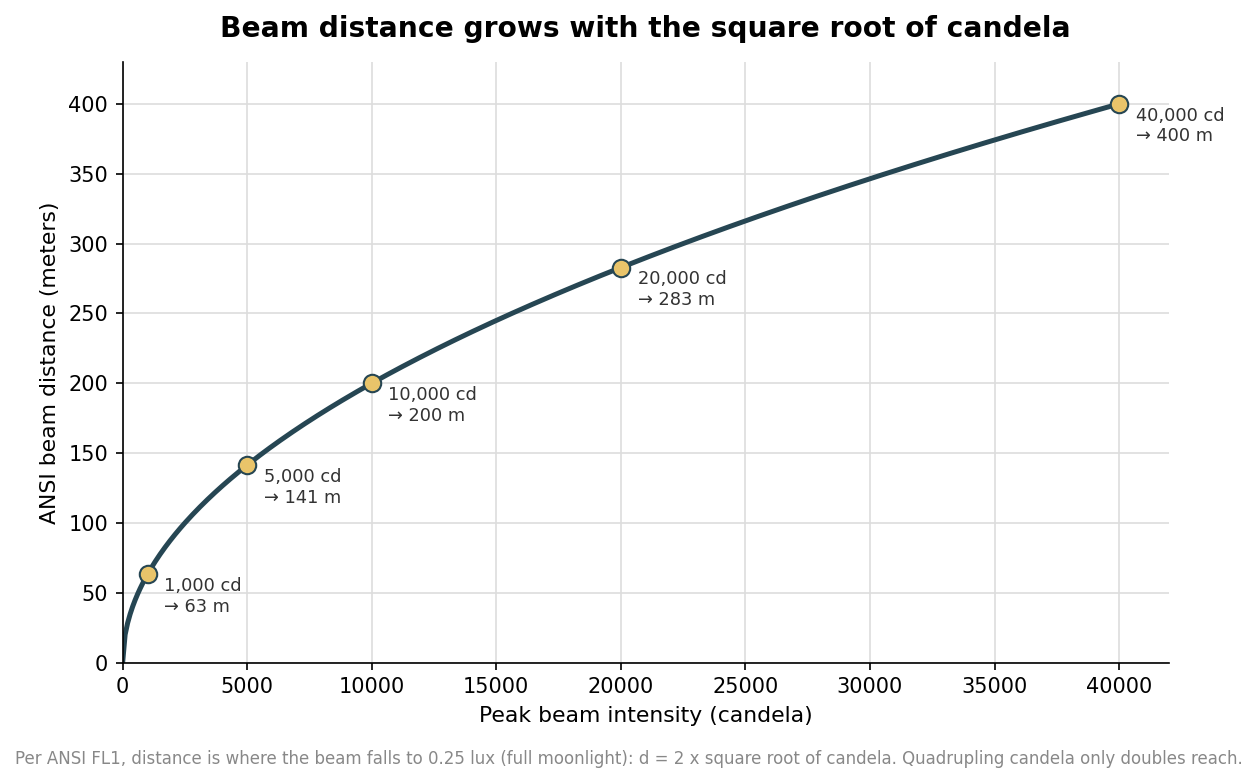
The takeaway for a purchase is to treat huge candela claims with perspective. Past a point, spending the specification on more throw yields diminishing distance, and that budget is often better put toward runtime, durability, or a better imprint.
Runtime, impact, and water resistance
Runtime under FL1 is the time from initial output until the light drops to 10 percent of that starting brightness, measured at the highest mode. This is why a well-regulated light that holds a flat output and then steps down can advertise a shorter runtime than a cheaper one that dims gradually from the first minute — the regulated light is more useful for longer even though the number looks smaller. Read runtime together with output, not on its own.
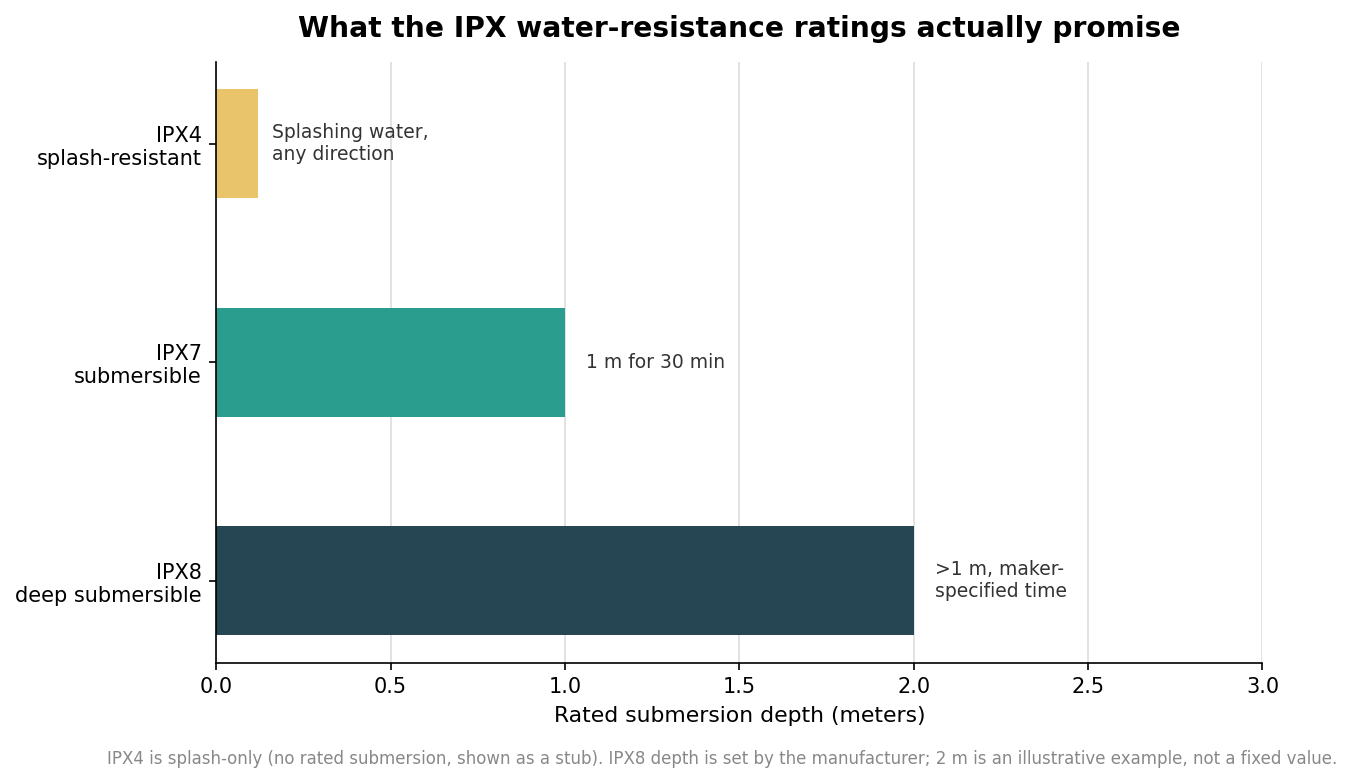
Impact resistance is a drop test: the rated figure in meters is the height from which the light survives six consecutive drops onto concrete without failing. Water resistance uses the familiar IPX scale, and the three levels you will see mean specific things. IPX4 covers splashing water from any direction but nothing submerged; IPX7 means the light survives submersion in one meter of water for 30 minutes; and IPX8 means it withstands deeper submersion for a duration the manufacturer specifies. The chart below lays out what each level actually promises so a spec does not oversell.
What actually matters for a branded order
Once the performance numbers make sense, a custom order adds a second set of decisions the spec sheet does not cover. The imprint method is the first. Laser engraving cuts the logo into anodized aluminum for a permanent, premium mark, but it shows only the underlying metal color rather than your brand palette; pad printing lays down a full-color logo on aluminum or plastic, at the cost of some durability as the print wears with handling. Choose engraving for tools people will keep and knock around, and pad printing when brand color is non-negotiable.
Material and power round out the choice. An anodized aluminum body feels substantial, sheds heat better, and takes an engraving cleanly, while an ABS plastic body is lighter and cheaper and suits high-volume giveaways. On power, disposable AAA or AA cells keep the unit price and shipping simple, whereas a built-in rechargeable lithium cell with USB-C is more convenient for the end user but carries battery-shipping considerations worth confirming before a large order. Promotional flashlights commonly land in a modest output range — very roughly 25 to 300 lumens — which is plenty for everyday carry; treat that as an indicative band rather than a rule, and match it to how the light will actually be used. As with any custom run, request a decorated sample and confirm the FL1 figures, imprint, and battery type in writing before you commit the full quantity.